Tehnology
Technical Description Upon the investor’s request, the design of the facility is carried out. The production of the project plan consists of modular units of various widths, with the most common dimensions being 120cm wide. We strive for the designed facilities to comply with all applicable regulations and ecological standards, providing comfort and functionality. The advantages of modular buildings compared to traditionally constructed ones are as follows:
Economical
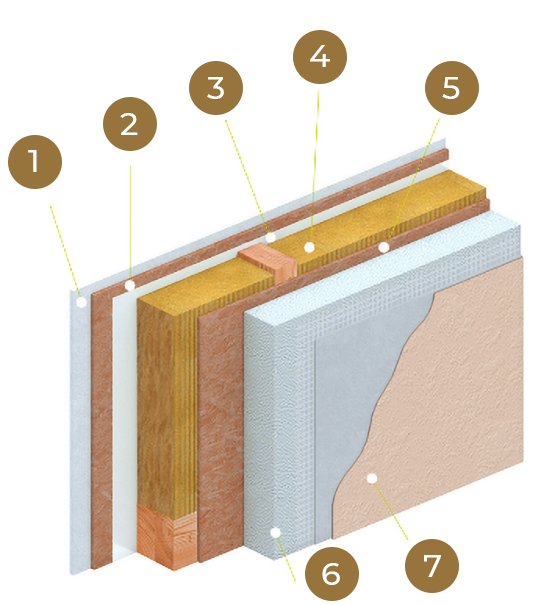
- Gypsum Board - 12.5 mm
- OSB Board (Inner) - 9 mm
- Vapor Barrier - 0.2 mm
- Wooden Structure - 80 mm
- Thermal Insulation - 80 mm
- OSB Board (Outer) - 9 mm
- Facade Insulation - 80 mm
- Adhesive with Mesh - 4 mm
- Facade Finish Layer - 1.5 mm
- Total Wall Thickness - 196.2mm
Classic
- Gypsum Board - 12.5 mm
- OSB Board (Inner) - 9 mm
- Vapor Barrier - 0.2 mm
- Wooden Structure - 100 mm
- Thermal Insulation - 100 mm
- OSB Board (Outer) - 9 mm
- Facade Insulation - 100 mm
- Adhesive with Mesh - 4 mm
- Facade Finish Layer - 1.5 mm
- Total Wall Thickness - 236.2mm
Premium
- Gypsum Board - 12.5mm
- OSB Board (Inner) - 9 mm
- Vapor Barrier - 0.2 mm
- Wooden Structure - 120 mm
- Thermal Insulation - 120 mm
- OSB Board (Outer) - 9 mm
- Facade Insulation - 100 mm
- Adhesive with Mesh - 4 mm
- Facade Finish Layer - 1.5 mm
- Total Wall Thickness - 256.2mm
Exclusive
- Gypsum Board - 12.5mm
- OSB Board (Inner) - 12 mm
- Vapor Barrier - 0.2 mm
- Wooden Structure - 120 mm
- Thermal Insulation - 120 mm
- OSB Board (Outer) - 12 mm
- Facade Insulation - 150 mm
- Adhesive with Mesh - 4 mm
- Facade Finish Layer - 1.5 mm
- Total Wall Thickness - 312.2mm
- Environmentally healthy homes: the primary building material is wood, which, due to its structure, color, and scent, is considered the healthiest construction material.
- Known fixed price at contract signing.
- Greater earthquake resistance: capable of withstanding ground movement up to 10 degrees on the Richter scale. Wood, as a building material, is more elastic than brick, block, or concrete.
- Better space utilization: walls are thinner than traditional ones, increasing window space utilization.
- Fire resistance: Fire resistance rating F-60min (IMS Belgrade). The gypsum boards covering the interior walls and ceilings of our houses are non-flammable.
- Better thermal insulation: Good thermal insulation of our buildings enables up to 40% energy savings per season.
- Better sound insulation: Mineral wool, which is a component of external and internal walls, besides its thermal properties, is also one of the best materials for sound insulation.
- Affordable price: Up to 40% savings compared to traditional solid construction. If we talk about the same thermal insulation properties, the price is up to 2.5 times lower.
- Fast construction: Since all modular elements are manufactured in our production facility, the actual construction time and time required for assembly of these finished elements are 4-7 days depending on the size of the facility. Construction under the “turnkey” system, from ordering to occupancy, does not exceed 60 days, or 30 days when it comes to construction under the “gray phase” system.
WALL ELEMENTS
Wall elements are usually made in modular dimensions of 120×260 and 60×260 cm, or according to other dimensions specified in the project plan. The elements are produced in the workshop according to the main project and delivered to the construction site. The elements can be external and internal, solid or with integrated windows and doors depending on their location within the facility. The element structure is a wooden frame d=100 mm, made of healthy pine wood. Verticals (intermediates) in the panel are placed at 40 cm intervals. All elements have double-sided cladding with OSB panels d=10 mm. Mineral wool is placed between the claddings or in the wooden frame, serving as thermal and sound insulation. External elements incorporate mineral wool d= 100mm, while internal elements incorporate d= 80 mm. Wall elements are assembled and joined into one unit using foundation strips d=100/140mm, window sills d=100/42mm, and wooden strips inserted into pre-made grooves. Foundation strips are pre-coated with bitumen and anchored to concrete walls.
After the assembly of the facility, the facade walls are covered with ‘izoterm’ cladding 80-120 mm thick, while internal walls are covered with gypsum board panels d=12.5 mm. Elements for sanitary rooms are covered with waterproof gypsum board panels d=12.5 mm. During the element production, flexible plastic pipes and junction boxes for distribution installations are installed.
Dimensions and composition of assembly walls:
External wall
- Facade finish 1.5mm
- Adhesive 3mm
- Facade mesh 1mm
- Expanded polystyrene (EPS) 80-120mm
- Adhesive 3mm
- OSB panel 9-12mm
- Wooden frame 80-120mm
- Mineral wool 80-120mm
- PVC foil 95g/m2 0.20mm
- OSB panel 9-12mm
- Gypsum board (waterproof gypsum board) 12.50mmTotal wall thickness 199.20mm-285.20mm
Internal wall
- Gypsum board 12.50mm
- OSB panel 9mm
- Wooden frame 80-100mm
- Mineral wool 80-100mm
- OSB panel 9mm
Gypsum board (moisture-resistant gypsum board) 12.50mm
Total wall thickness 123mm-143mm
CARPENTRY
Joinery is made of six-chamber PVC profiles. The selection and sizing of openings are made according to the requirements of the rooms where they are installed. The construction of windows and doors is designed to be integrated into the wall elements during their production in the workshop or on-site after the assembly of the elements.
Windows and balcony doors are double, two-part, with tilt-and-turn opening around the vertical and horizontal axes using edge locks. Joinery is glazed with triple thermal insulation glass filled with argon 4+12+4 mm. Aluminum sills in the color of the joinery are installed on the exterior side. Entrance doors are 95/225 cm single-leaf partially glazed, without transom, with a combination division made of PVC profiles, equipped with a security lock. Internal doors are double-leafed 90/205, 80/205 and 70/205 cm. Entrance doors are secured with a security lock with a cylinder, while other doors have ordinary locks.
ROOF ELEMENTS
The roof structure is made of truss roof beams. Roof beams are made in a truss system with two-part belts and one-part or three-part infill rods, with connections made by nails in the zone of belts. Roof beams are made in the workshop from dried healthy pine wood class I/II according to the static calculation. The beams are mounted over the wall construction on modular supports (up to 120 cm) and anchored using metal “U” profiles. Roof beams are interconnected with plank sheathing d=24 mm in roof planes and vertical bracing, achieving spatial stability of the roof and the facility. Over the plank sheathing, a breathable membrane is installed, along with longitudinal and transverse battens 30/48 mm to provide ventilation under the roof covering. Roof covering is done with interlocking tiles. The roof edges are finished with OSB panels d=15mm, attached to a wooden frame. Roof ridges are finished with processed boards. The areas under the roof beams are covered with aluminum siding or facade material similar to external walls. All roof structure connections are made with appropriate nails.
CEILING CONSTRUCTION
The ceiling construction consists of joists, insulation material, and ceiling cladding. A grill of CD profiles is placed over the lower belts of the roof beams, followed by a vapor barrier of PVC foil and ceiling cladding.
Over the grill and ceiling cladding, thermal insulation of mineral wool d=100-200mm is installed. Ceiling cladding is made of gypsum board panels d=12.5 mm with the following composition:
Ceiling
- Gypsum board panel 12.5mm
- Metal (galvanized) structure 30mm
- PVC foil 95g/m2 0.15mm
- Lower belt of truss roof beam According to the static calculation
- Mineral wool 100-200mm
OTHER ASSEMBLY WORKS
All columns and lintels are made of high-quality laminated pine wood according to the project.
GLAZING
Glazing of facade joinery is done with double thermal insulation glass filled with argon.
SHEET METAL WORKS
Standard gutters with appropriate number of downpipes are installed on the facility. Gutters are made of painted sheet metal. Wind deflectors, aluminum sills, and chimney flashing are made of painted sheet metal.
FLOORING
In sanitary facilities, kitchen, and pantry, floors are made of glazed ceramic tiles, while in other rooms, laminate flooring d=7-9mm, click system class 3-1, HDF substrate is installed. At the entrance and entrance stairs, unglazed ceramic tiles are laid.
Floor construction
- Laminate 7-9mm
- Cement screed 40-60mm
- PVC foil 0.15mm
- Hard-pressed polystyrene foam (styrofoam) 20-100mm
- Waterproofing (bitumen strips) 4mm
INTERNAL FINISHING
Ceilings are painted with semi-gloss white paint. Internal wall finish is done with semi-gloss paints. All internal surfaces are treated with two coats, including necessary preparatory work such as plastering or filling any irregularities on the surfaces to be treated. Sanitary room walls are tiled to the ceiling, kitchen walls to a height of 160cm, and above they are painted with semi-gloss white paint.
EXTERNAL FINISHING
The exterior surfaces are finished with plastic smoothed facade based on silicone. All wooden exterior surfaces are painted with Sadolin in two coats. The choice of tones for finishing all surfaces is made by the investor.
WATER SUPPLY AND SEWERAGE
Water supply and sewerage are done according to a separate project. The water supply network is surface-mounted and is done with hydraulic pipes for supplying hot and cold water and sewerage PVC pipes of appropriate size. All parts of the water supply network are mounted on the wall and secured with appropriate PVC clamps. Water supply and sewerage installations are done with outlets at 1m from the facility without building shafts and installing water meters. All sanitary ware is white. Sanitary fixtures are installed according to the construction project.
ELECTRICAL INSTALLATIONS
Electrical installation is done according to a separate project and applicable regulations for modular facilities. All wiring is done with PGP cables installed in walls and routed above the ceiling in the attic space, over special boards, secured with clamps. The installation is done with an outlet from the roof beam or cassette on the wall. Room lighting is done with ordinary lamps (bulbs) of appropriate capacity depending on the purpose of the room. As an additional protection measure, a residual current device (RCD) is installed.
Upon the investor’s request, the design of the facility is carried out. The production of the project plan consists of modular units of various widths, with the most common dimensions being 120cm wide. We strive for the designed facilities to comply with all applicable regulations and ecological standards, providing comfort and functionality. The advantages of modular buildings compared to traditionally constructed ones are as follows:
- Environmentally healthy homes: the primary building material is wood, which, due to its structure, color, and scent, is considered the healthiest construction material.
- Known fixed price at contract signing.
- Greater earthquake resistance: capable of withstanding ground movement up to 10 degrees on the Richter scale. Wood, as a building material, is more elastic than brick, block, or concrete.
- Better space utilization: walls are thinner than traditional ones, increasing window space utilization.
- Fire resistance: Fire resistance rating F-60min (IMS Belgrade). The gypsum boards covering the interior walls and ceilings of our houses are non-flammable.
- Better thermal insulation: Good thermal insulation of our buildings enables up to 40% energy savings per season.
- Better sound insulation: Mineral wool, which is a component of external and internal walls, besides its thermal properties, is also one of the best materials for sound insulation.
- Affordable price: Up to 40% savings compared to traditional solid construction. If we talk about the same thermal insulation properties, the price is up to 2.5 times lower.
- Fast construction: Since all modular elements are manufactured in our production facility, the actual construction time and time required for assembly of these finished elements are 4-7 days depending on the size of the facility. Construction under the “turnkey” system, from ordering to occupancy, does not exceed 60 days, or 30 days when it comes to construction under the “gray phase” system.
After clearing the site and removing the topsoil layer, the facility is marked at the specified location, after which trenches are dug for the foundation beams. The foundation strips are founded at the depth provided by the project. They are made of machine concrete, below which a layer of compacted gravel or crushed stone is placed. The plinth walls are built over the foundation beams in double wooden formwork. The thickness of the walls is 20-25 cm, depending on the site conditions, and the height is 45 cm from the sidewalk level. Reinforced concrete belts are made above the plinth beams. Between the plinth walls, earth is filled and compacted in layers to the required height, over which a layer of gravel is placed to serve as a base for the concrete floor slab. The concrete slab is made of compacted concrete, about 10 cm thick. Over the plinth walls and the floor (first) slab, a waterproofing is applied using hot bitumen coating and condor in 2+1 layers, in two phases. In the first phase (before the assembly of the facility), waterproofing is done in strips 25-30 cm wide below the foundations, and in the second phase (after the assembly of the facility) on the remaining surface.
OTHER CONSTRUCTION WORK
The facility is designed to have one single-channel chimney with a cross-section of 16 cm. It is built from prefabricated schiedel elements and finished with a prefabricated concrete cap. Masonry is carried out after the first phase of facility assembly. The chimney is equipped with a cleaning revision and a connection for a stove.
WALL ELEMENTS
Wall elements are usually made in modular dimensions of 120×260 and 60×260 cm, or according to other dimensions specified in the project plan. The elements are produced in the workshop according to the main project and delivered to the construction site. The elements can be external and internal, solid or with integrated windows and doors depending on their location within the facility. The element structure is a wooden frame d=100 mm, made of healthy pine wood. Verticals (intermediates) in the panel are placed at 40 cm intervals. All elements have double-sided cladding with OSB panels d=10 mm. Mineral wool is placed between the claddings or in the wooden frame, serving as thermal and sound insulation. External elements incorporate mineral wool d= 100mm, while internal elements incorporate d= 80 mm. Wall elements are assembled and joined into one unit using foundation strips d=100/140mm, window sills d=100/42mm, and wooden strips inserted into pre-made grooves. Foundation strips are pre-coated with bitumen and anchored to concrete walls.
After the assembly of the facility, the facade walls are covered with ‘izoterm’ cladding 80-120 mm thick, while internal walls are covered with gypsum board panels d=12.5 mm. Elements for sanitary rooms are covered with waterproof gypsum board panels d=12.5 mm. During the element production, flexible plastic pipes and junction boxes for distribution installations are installed.
Dimensions and composition of assembly walls:
External wall
- Facade finish 1.5mm
- Adhesive 3mm
- Facade mesh 1mm
- Expanded polystyrene (EPS) 80-120mm
- Adhesive 3mm
- OSB panel 9-12mm
- Wooden frame 80-120mm
- Mineral wool 80-120mm
- PVC foil 95g/m2 0.20mm
- OSB panel 9-12mm
- Gypsum board (waterproof gypsum board) 12.50mmTotal wall thickness 199.20mm-285.20mm
Internal wall
- Gypsum board 12.50mm
- OSB panel 9mm
- Wooden frame 80-100mm
- Mineral wool 80-100mm
- OSB panel 9mm
Gypsum board (moisture-resistant gypsum board) 12.50mm
Total wall thickness 123mm-143mm
CARPENTRY
Joinery is made of six-chamber PVC profiles. The selection and sizing of openings are made according to the requirements of the rooms where they are installed. The construction of windows and doors is designed to be integrated into the wall elements during their production in the workshop or on-site after the assembly of the elements.
Windows and balcony doors are double, two-part, with tilt-and-turn opening around the vertical and horizontal axes using edge locks. Joinery is glazed with triple thermal insulation glass filled with argon 4+12+4 mm. Aluminum sills in the color of the joinery are installed on the exterior side. Entrance doors are 95/225 cm single-leaf partially glazed, without transom, with a combination division made of PVC profiles, equipped with a security lock. Internal doors are double-leafed 90/205, 80/205 and 70/205 cm. Entrance doors are secured with a security lock with a cylinder, while other doors have ordinary locks.
ROOF ELEMENTS
The roof structure is made of truss roof beams. Roof beams are made in a truss system with two-part belts and one-part or three-part infill rods, with connections made by nails in the zone of belts. Roof beams are made in the workshop from dried healthy pine wood class I/II according to the static calculation. The beams are mounted over the wall construction on modular supports (up to 120 cm) and anchored using metal “U” profiles. Roof beams are interconnected with plank sheathing d=24 mm in roof planes and vertical bracing, achieving spatial stability of the roof and the facility. Over the plank sheathing, a breathable membrane is installed, along with longitudinal and transverse battens 30/48 mm to provide ventilation under the roof covering. Roof covering is done with interlocking tiles. The roof edges are finished with OSB panels d=15mm, attached to a wooden frame. Roof ridges are finished with processed boards. The areas under the roof beams are covered with aluminum siding or facade material similar to external walls. All roof structure connections are made with appropriate nails.
CEILING CONSTRUCTION
The ceiling construction consists of joists, insulation material, and ceiling cladding. A grill of CD profiles is placed over the lower belts of the roof beams, followed by a vapor barrier of PVC foil and ceiling cladding.
Over the grill and ceiling cladding, thermal insulation of mineral wool d=100-200mm is installed. Ceiling cladding is made of gypsum board panels d=12.5 mm with the following composition:
Ceiling
- Gypsum board panel 12.5mm
- Metal (galvanized) structure 30mm
- PVC foil 95g/m2 0.15mm
- Lower belt of truss roof beam According to the static calculation
- Mineral wool 100-200mm
OTHER ASSEMBLY WORKS
All columns and lintels are made of high-quality laminated pine wood according to the project.
GLAZING
Glazing of facade joinery is done with double thermal insulation glass filled with argon.
SHEET METAL WORKS
Standard gutters with appropriate number of downpipes are installed on the facility. Gutters are made of painted sheet metal. Wind deflectors, aluminum sills, and chimney flashing are made of painted sheet metal.
FLOORING
In sanitary facilities, kitchen, and pantry, floors are made of glazed ceramic tiles, while in other rooms, laminate flooring d=7-9mm, click system class 3-1, HDF substrate is installed. At the entrance and entrance stairs, unglazed ceramic tiles are laid.
Floor construction
- Laminate 7-9mm
- Cement screed 40-60mm
- PVC foil 0.15mm
- Hard-pressed polystyrene foam (styrofoam) 20-100mm
- Waterproofing (bitumen strips) 4mm
INTERNAL FINISHING
Ceilings are painted with semi-gloss white paint. Internal wall finish is done with semi-gloss paints. All internal surfaces are treated with two coats, including necessary preparatory work such as plastering or filling any irregularities on the surfaces to be treated. Sanitary room walls are tiled to the ceiling, kitchen walls to a height of 160cm, and above they are painted with semi-gloss white paint.
EXTERNAL FINISHING
The exterior surfaces are finished with plastic smoothed facade based on silicone. All wooden exterior surfaces are painted with Sadolin in two coats. The choice of tones for finishing all surfaces is made by the investor.
WATER SUPPLY AND SEWERAGE
Water supply and sewerage are done according to a separate project. The water supply network is surface-mounted and is done with hydraulic pipes for supplying hot and cold water and sewerage PVC pipes of appropriate size. All parts of the water supply network are mounted on the wall and secured with appropriate PVC clamps. Water supply and sewerage installations are done with outlets at 1m from the facility without building shafts and installing water meters. All sanitary ware is white. Sanitary fixtures are installed according to the construction project.
ELECTRICAL INSTALLATIONS
Electrical installation is done according to a separate project and applicable regulations for modular facilities. All wiring is done with PGP cables installed in walls and routed above the ceiling in the attic space, over special boards, secured with clamps. The installation is done with an outlet from the roof beam or cassette on the wall. Room lighting is done with ordinary lamps (bulbs) of appropriate capacity depending on the purpose of the room. As an additional protection measure, a residual current device (RCD) is installed.